Category » Simple Two Hands Diabolo Siteswap

  • If diabolo matters to you the way it does to me, you might want a way to write down what you’re doing and come back to it later. That’s what brought me to siteswap for diabolo.

    Siteswap gives me a way to write diabolo patterns with a shared structure. It’s a transpositional notation: the numbers describe the time until an object returns to be thrown again. In practice, a sequence becomes a rhythm of returns, and different physical interpretations can sit on top of the same structure.

    In diabolo this becomes useful as soon as patterns branch into variants and transitions. Writing them down helps me compare versions, track what changed, and communicate a pattern without relying on informal names. The point is documentation and precision: a small piece of language that makes it easier to revisit a pattern and share it.

    Why did I research on diabolo siteswap?

    When I started looking into diabolo siteswap, I kept running into a gap: the notations I found were useful for certain patterns, but they didn’t cover the range of material I was actually working on. So I took the standard juggling siteswap as the base and adapted it to diabolo, keeping the transpositional idea while adding what diabolo practice demands.

    A lot of diabolo siteswap is written with a “one-handed” model in mind. That works well for regular aerial carousels, but my practice regularly involves two hands with different roles, time on the string, and patterns that don’t behave like a single channel. I also work with parallel structures where a diabolo can return to the same hand, and with switch / body orientation changes that affect how a pattern is organised.

    The notation I’m proposing is an attempt to make those parts explicit: hands, roles, and returns via the string, while staying compatible with siteswap as a shared language. The goal isn’t a closed system. It’s a workable way to write patterns, compare variants, and communicate them without losing important structure.

    That shared base matters beyond the diabolo community. Using siteswap as the common ground makes it easier to connect diabolo patterns with other juggling disciplines, and to talk about structure without reinventing vocabulary every time.

    In this webpage I describe the approach in more detail and show how the notation handles the kinds of patterns I care about.

    Teaser video of Diabolo Siteswap

    A short video to see how the notation works in practice: return rhythm, hand roles, and a few basic examples.

    Why saying “3 Diabolos Low” is just the beginning

    When we say that we juggle with five balls we suppose that we juggle the normal cascade (5). However, we can juggle five balls like a shower (91) or a half-shower (73), etc. The same goes for the diabolo. When we say that we achieved 3 Diabolos Low nowadays we know what it means but how many ways exist for juggling 3 Diabolos Low? If you go deep into this siteswap it becomes obvious that juggling has no limits.

    All the siteswap patterns that I propose for the diabolo are only a few samples of what is actually possible and should not be mistaken for the only way to do it – there exists an infinity of different diabolo-patterns.

    You can download Juggling Lab, which I have modified to include diabolos, from the bottom of this site. With this software, you can have fun while learning the concepts discussed on this site.

    Important points to keep in mind when juggling diabolos

    1. The diabolos spend very little time in our “hands”, so the dwell time is quite low.
    2. When referring to throws made with the string, we assume that half of the string is on the right and the other half is on the left. However, the hand that generates the throw could be the other hand or both.
    3. When juggling diabolos, we can think of the string as a surface where we can control the time that the diabolo spends (similar to table juggling). To indicate when the diabolo is on the string, we use bouncing notation and put an “F” after the number that we throw (_F).
    4. While we usually catch and throw the diabolo using the string, we can also catch it with our hands.
  • This notation is essentially a translation of the bouncing ball notation applied to diabolo. We will use the common understanding that when the diabolo is on the string, it behaves as if it’s on a controlled surface, similar to how a ball behaves when rolled on a table or bounced on the ground.

    Asyncronich Notation

    0 . Nothing inside of the string.

    1 . The diabolo goes directly from one side of the string/hand to the other.

    2 . Retention of the diabolo in the string, stick, or hand.

    3 . The diabolo goes through the air from one side of the string/hand to the other and it spends in the air the time of three ones.

    4. The diabolo is thrown to the same side of the string and it spends in the air the time of four ones.

    5. The diabolo goes on the air from one hand to the other and it spends in the air the time of five ones.

    6.  The diabolo is thrown to the same side.

    etc…

    Syncronich Notation

    In the syncronic notation we throw and catch the diabolos simultaneously and we must write de siteswap in between brackets like that (left throw, rigth throw).  Also in the syncronic notation we do not use odd numbers. We put an x after the number to say that that throw crosses.

    To explain this notation I will write only the throws of the left hand.

    (2,0) . The diabolo stays in one side of the string.

    (2x,0) . The diabolo goes from one hand to the other through the air.

    (4,0) . The diabolo is thrown to the same side of the string and it spends in the air the time of four ones.

    (4x,0). The diabolo goes from one side of the string to the other by the air.

    etc..

    Specific notation for the string

    B —  Bounce the throw off the floor. The format is to put as many B’s as you want bounces, followed by the style of the bounce:

    BL or L for lift bouncing

    BF or F for force bouncing

    BHL or HL  for hyperlift bouncing (for a description of hyperforce/hyperlift bouncing, see this discussion on rec.juggling)

    BHF or HF for hyperforce bouncing

    Usually we will use BF or F because when we recive the diabolo from the air, we force it to enter in the string but there are some patterns where it is useful only to use B, like in the 3 diabolos Low Cascade.

    You can find more information about the specific notation here

    Asinch String Notation for the string [ _F ]

    1F . Diabolo goes from one side of the string to the other.

    2F . Retention of the diabolo in the string.

    3F .   The diabolo goes by the string from one hand to the other and it spends in the string the time of four ones.

    4F .  Retention of the diabolo in the string and it spends in the string the time of four ones..

    5F .  Retention of the diabolo in the string and it spends in the string the time of four ones..

    etc…

    Sinch String Notation for the string ( _F )

    (2xF,0) . The diabolo goes from one hand to the other by the string (2 Diabolo Low Synch rythm, or the Diabolo that goes on the rope in High)

    (2xF,0) . The diabolo goes from one hand to the other by the string (2 Diabolo Low Synch rythm, or the Diabolo that goes on the rope in High)

    (4F,0). Diablo goes from one side of the string to the other by the string. ( 3 Diabolo Synch Low Rythm)

    (4xF,0).  Diablo goes from one side of the string to the other by the string. ( 3 Diabolo Synch Low Rythm)

    etc..

    *** Folowing you can see some examples ***

    *** All the examples are done with JugglingLAB ***

  • 1 Diabolo

    Basics

    1D Orbits → Siteswap = 3F00300
    1D |423| → Siteswap = 3F004000

    Suns

    1D Slow Sun → Siteswap = 3003F00
    1D Quick Sun → Siteswap = 1T1F

    We can mix Slow and Fast suns and do “3001F” or “13F00”, that is usefull with 2 or more diabolos.

  • 2 Diabolos Synch

    In 2 diabolo synch patterns both hands throw at the same time, sharing the same rhythm. Here you can see a basic low synch shuffle, (2xF,2x), and two higher synch patterns, (4xF,4x)(0,0) and (6x,0)(0,2xF), where the diabolos reach a greater height. When you practise these shuffles, focus on keeping both hands synchronized and maintaining a clear, consistent spacing between the two diabolos.

    Suffles

    2 diabolo shuffle siteswap (2x,2xF) animation
    2D Low Synch Siteswap . (2xF,2x)
    2D High Synch Siteswap . (4xF,4x)(0,0)
    2 diabolo shuffle siteswap (6x,0)(0,2xF) animation
    2D High Synch Siteswap . (6x,0)(0,2xF)
  • 3 Diabolos Asynch

    There’s a wide array of asynchronous patterns with 3 diabolos, each reflecting different styles and personalities. These patterns involve intricate timing and figures, demanding adaptability and finesse to juggle them effectively. Which pattern aligns best with your style? And which is harder for you to do but will mean a lot to consolidate?

    3D Low Asynch Siteswaps

    This asynchronous low shuffle pattern, 33F, highlights the fundamental timing and positioning for three diabolos. The 15F is a more active pattern and harder to accomplish.

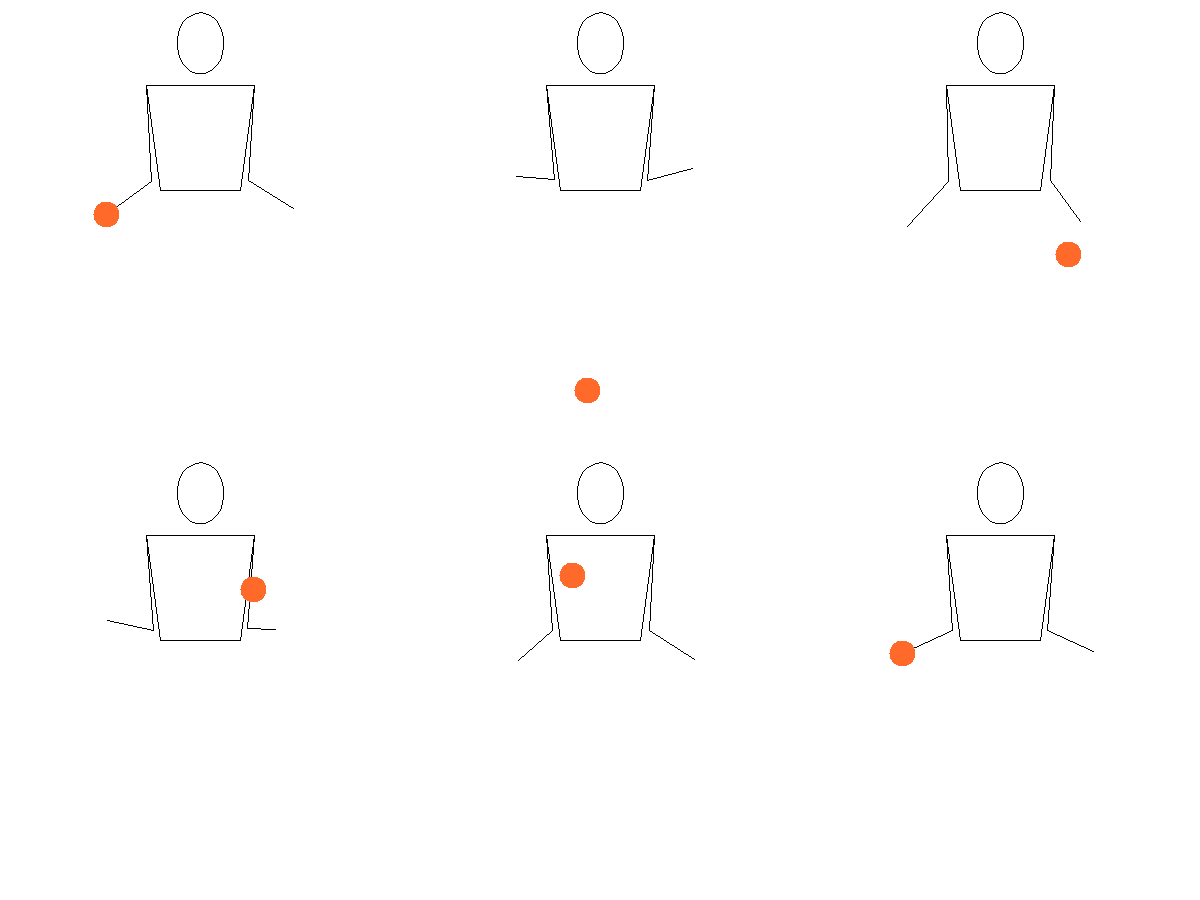
    3 diabolo shuffle siteswap 5F1 animation
    3D Low Asynch Siteswap . 5F1
    3 diabolo shuffle siteswap 3F3 animation
    3D Low Asynch Siteswap . 3F3

    3D Medium Asynch Siteswaps

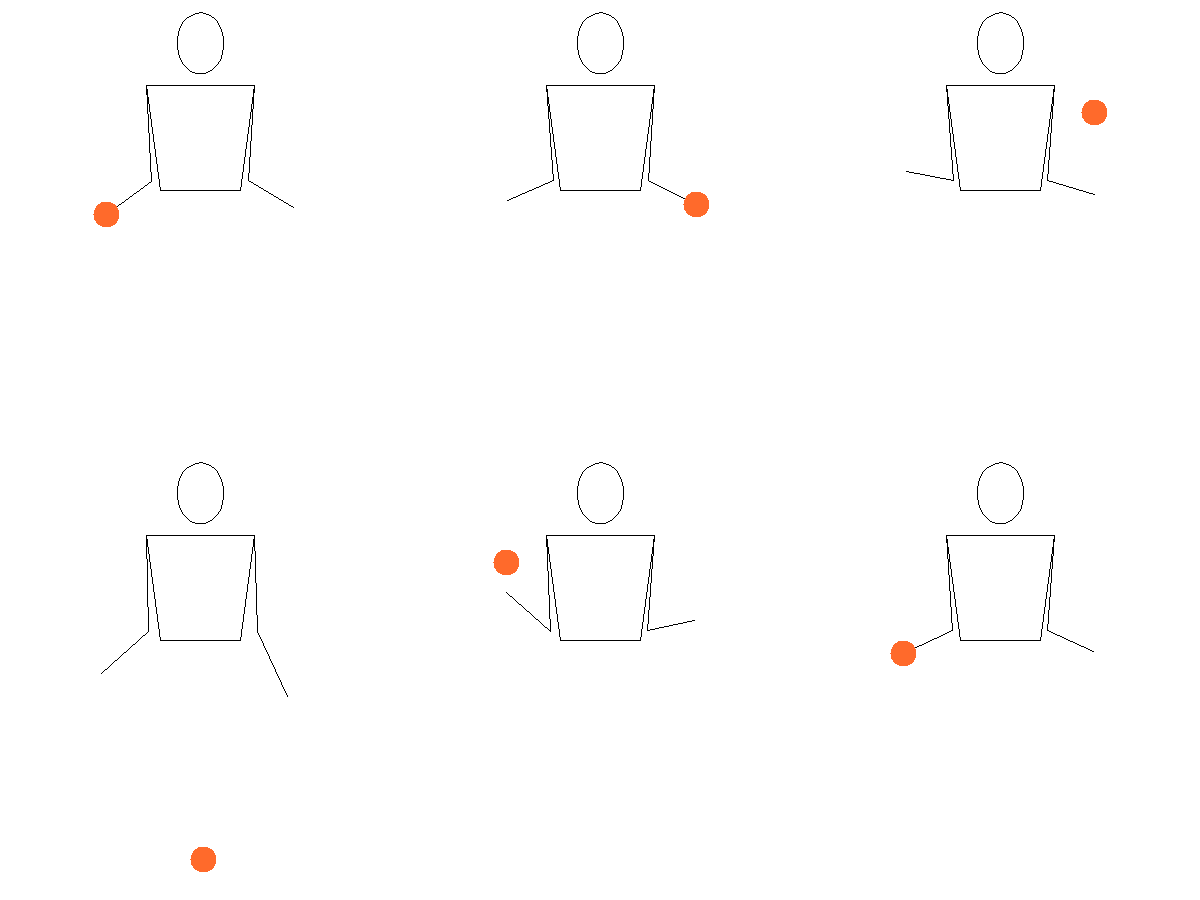
    The 7005F pattern transitions from low to high throws, demonstrating a mix of heights in an asynchronous shuffle.

    3 diabolo shuffle siteswap 1F5 animation
    3D Low Asynch Siteswap . 1F5
    3 diabolo shuffle siteswap 5F700 animation
    3D Low-High Asynch Siteswap . 5F700

    3D High Asynch Siteswaps

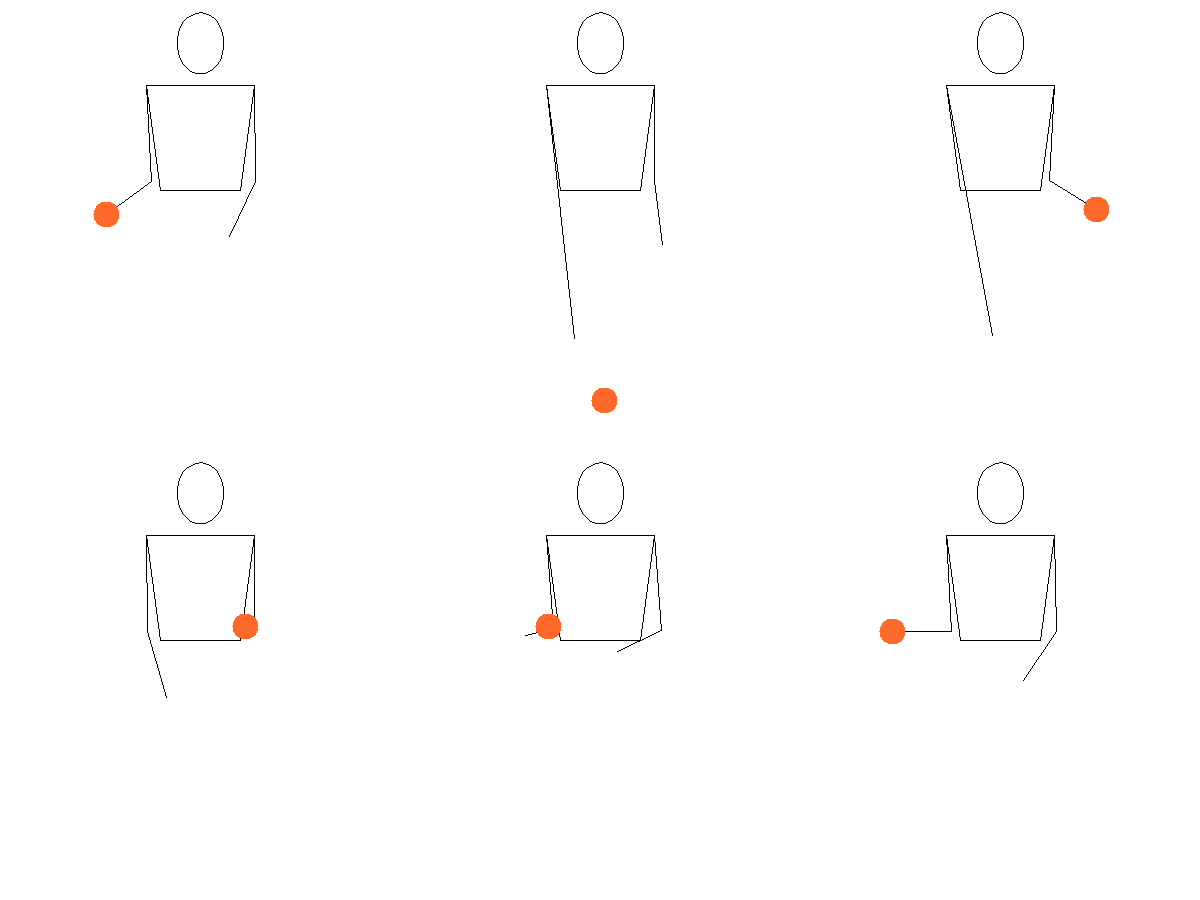
    In the 93F00 pattern, we observe increased height and varied timing, showcasing a high asynchronous shuffle. Most people, when starting to practice three diabolo high patterns, do b001F, where the diabolo moves along the string faster, becoming a higher pattern that is more difficult to maintain.

    3 diabolo high asynch shuffle siteswap 3F009 animation
    3D High Asynch Siteswap . 3F009
    3 diabolo high asynch shuffle siteswap 1Fb00 animation
    3D High Asynch Siteswap . b001F

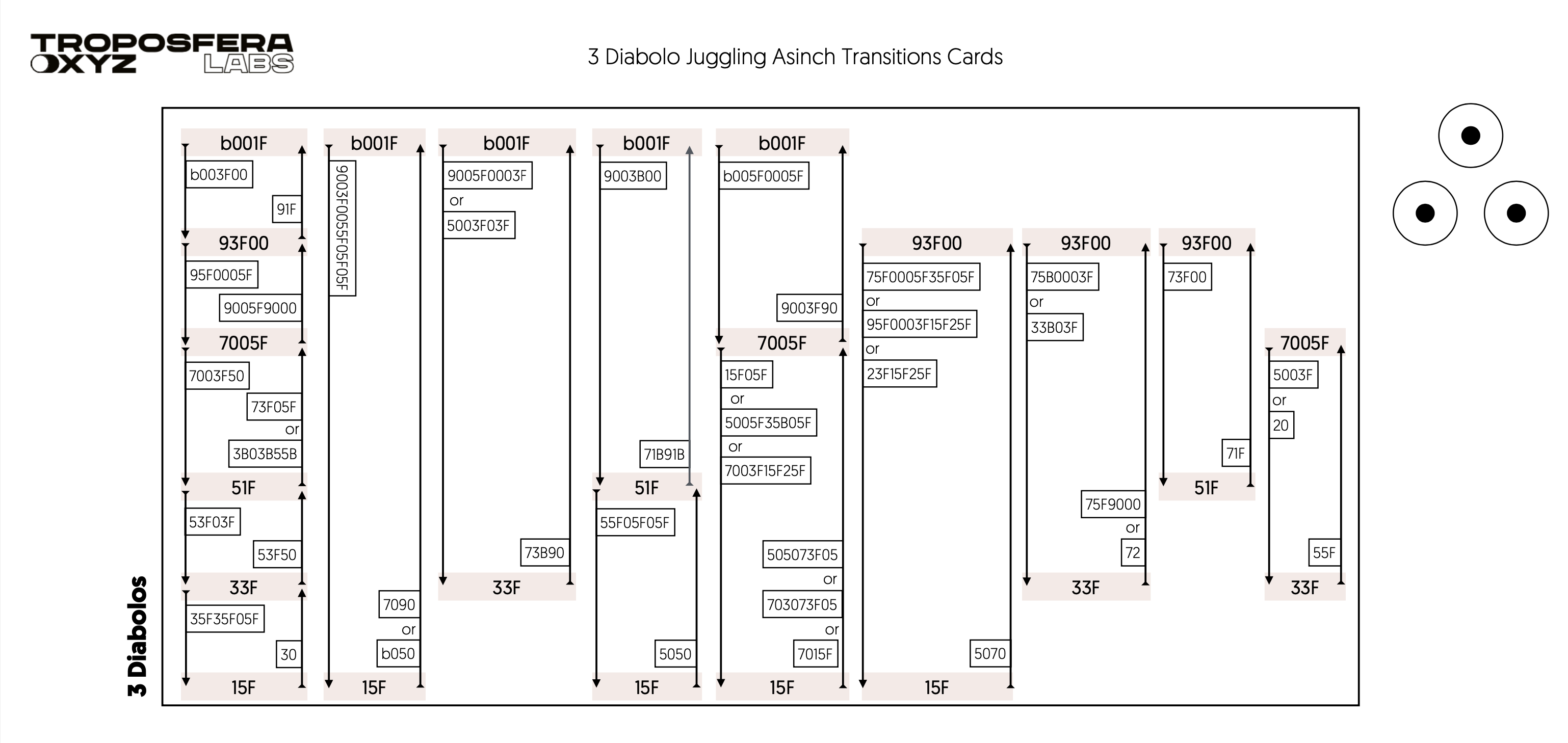
    3 Diabolos State Transitions [stairs]

    3 Diabolo State Transitions from the cards Animation
    3D Transitions Asynch for the SitesWap

    Transitioning between states and patterns wiht 3 diabolo is essential for learning new tricks. There are a lot of transitions, so you can go from each patern to another directly, is only about to know the correct transition patern.

    This transitions require fluidity and precision. Just as each step leads seamlessly to the next, moving between diabolo states demands smooth movement and timing.

    So I made a transitions table so you can know how to transition between patterns, download it and practice.

    Other Trikcs 3 diabolo tricks

    3 Diabolo - 3F522 - Diabolo Siteswap - troposfera.xyz
    3D Feed the Sun Sitewswap. 5223F
    3 Diabolo - 3F53F1 - Diabolo Siteswap - troposfera.xyz
    3D “42” Sitewswap. 53F13F
    3 Diabolo - 4440 - Diabolo Siteswap - troposfera.xyz
    3D Low minicolums Sitewswap. 4440
  • 3 Diabolos Synch

    SYNHC 3D - Diabolo Siteswap troposfera.xyz by Dídac Gilabert

    3 Diabolo Synch Low

    This synchronous low shuffle pattern features (4xF,2x), emphasizing foundational timing and positioning for three diabolos.

    3 diabolo synch shuffle siteswap (4xF,2x) animation
    3D low Synch Siteswap . (4xF,2x)
    3 diabolo synch shuffle siteswap (4x,2xF) animation
    3D low Synch Siteswap . (2xF,4x)

    3 Diabolo Synch Medium

    Transitioning between (0,6x)(6xF,0), this pattern showcases a blend of heights and complexities in synchronous juggling.

    3 diabolo synch shuffle siteswap (0,6xF)(6x,0) animation
    3D Low-High Synch Siteswap . (0,6x)(6xF,0)

    3 Diabolo Synch High

    With (4xF,8x)(0,0), this high synchronous pattern highlights increased throws and varied timing, challenging even experienced jugglers.

    3 diabolo synch shuffle siteswap (8x,4xF)(0,0) animation
    3D High Synch Siteswap . (4xF,8x)(0,0)
    3 diabolo synch shuffle siteswap (ax,0)(0,2xF) animation
    3D High Synch Siteswap . (ax,0)(0,2xF)
  • Suffles

    4 Diabolo - 5F3 - Diabolo Siteswap - troposfera.xyz
    4D Low Asynch → Siteswap = 35F
    4 Diabolo - 3F5 - Diabolo Siteswap - troposfera.xyz
    4D Low Asynch → Siteswap = 53F
    4 Diabolo - 5Fb00 - Diabolo Siteswap - troposfera.xyz
    4D Low-High Asynch → Siteswap = b005F
    4D High Asynch → Siteswap = d3F00